Thursday, 18 January 2024

Physics viva important question 2024 by Gurleen


1. To determine resistivity of two / three wires by plotting a graph for

potential difference versus current.

1. Define Ohm’s law.

Answer. The current flows through conductors is directly proportional to the voltage

applied. The voltage across a conductor is directly proportional to the current flowing through

it, provided all physical conditions and temperatures remain constant.

2. What is the formula of Ohm’s law?

Answer. Ohm’s law is given by the formula: V=IR

Where, I=current, V=voltage, and R=Resistance.

3. What is specific resistance?

Answer. The resistance offered per unit length and unit cross-sectional area when a known

amount of voltage is applied is known as the specific resistance. S.I unit ohm-meter

4. What is the SI unit of the potential difference?

Answer. The SI unit of the potential difference is volt.

5. The current is measured in which unit? And which instrument

Answer. The unit of electric current is Ampere and Ammeter

6. What is the unit of resistance?

Answer. The unit of the electrical resistance is Ohms.

7. Does the resistance depend on the temperature?

Answer. Yes, the resistance depends on the temperature. As the temperature increases, the

resistance also increases for conductor.

8. What are the various sources of error while performing this experiment?

Answer: Various sources of error are:

 The instrument screws may be loose.

 Lack of thick connecting wires.

 Using rheostat of high resistance.

9. What is electrical conductivity?

Answer. It is the measure of the ability of the material to allow the electric current to pass

through it.

10. Define a rheostat.

Answer. A rheostat is a two-terminal electrical device. The rheostat is a variable resistor

whose resistance can be changed to change the current flowing amount through a circuit.

11. State true or false: The potential difference across the wire varies linearly with the current.

Answer. TRUE. The potential difference across the wire varies linearly with the current.

12. Does the resistance depend on the dimensions of the conductor?

Answer. Yes, the resistance depends on the dimensions of the conductor.

 R = ρ l/A

2. To find resistance of a given wire / standard resistor using metre

bridge.

Q1. Why is the metre bridge called so?

Ans: It is called a metre bridge because the bridges use one-meter long wire.

Q2. What is the null point?

Ans: Null point is defined as the point at which a galvanometer reads 0 deflections.

Q3. Why is the bridge method better than the Ohms law of measurement?

Ans: Bridge method is better than the Ohms law of measurement because of the null

method.

Q4. What is the range of measurement of resistance using a Wheatstone bridge?

Ans: The resistance measurement range using a Wheatstone bridge is between 1Ω to a

few megaohms.

Q5. How can a Wheatstone bridge be used for the measurement of physical

parameters?

Ans: Wheatstone bridge is used to measure the physical parameters like temperature,

light, etc, using an operational amplifier and rectifiers are used for the conversion of

A.C to D.C.

3. To verify the laws of combination(series) of resistances using a metre

bridge.

1) What is a metre bridge?

A slide wire bridge, also termed a metre bridge, is an instrument that works on the

principal Wheatstone bridge. To find unknown resistance of a conductor, a metre

bridge is used.

2) In a series combination of resistance, how do you find the equivalent

resistance?

Since the same current passes through each resistor in series combination, the total

resistance RT can be calculated using the below equation:

RT = R1+ R2 + R3 + …….Rn

3) What is Wheatstone bridge?

A Wheatstone bridge is a particular type of electrical circuit that is used in measuring

the unknown electrical resistance of the circuit by balancing the two legs of the bridge

circuit, where the unknown component includes one of its legs.

4) What is the use of a metre bridge?

To measure the resistance precisely for a resistor, a metre bridge is used.

5) Which principle is followed by the metre bridge for its working?

The principle of the Wheatstone bridge is followed by a metre bridge for its efficient

working.

6) Which material wire is used in a metre bridge?

The materials such as nichrome, constantan or manganin are used in making the wire

of a metre bridge because these materials have a high value of resistance, and the

coefficient of the temperature of their resistances is low.

7) What is the case when the metre bridge is in a more sensitive condition?

The metre bridge circuit will be very sensitive when all four resistors have the same

resistance values.

8) What is the balanced condition of a Wheatstone bridge?

When no current flows through the galvanometer, the Wheatstone bridge is said to be

in a balanced condition. By adjusting the known resistance and variable resistance,

this condition can be achieved.

9) What is the working principle of a Wheatstone bridge?

It is the principle of null deflection which is responsible for the working of a 

Wheatstone bridge, i.e. no current flows through the circuit, and the ratio of their 

resistances are equal.

10) What are the restrictions of Wheatstone bridge?

The resistance of the leads and contacts becomes important for low resistance 

measurement, but the Wheatstone bridge shows errors while measuring them.

4. To determine resistance of a galvanometer by half- deflection method and

to find it’s figure of merit.

1. What is a galvanometer?

Answer: A galvanometer is a measuring device that measures a small electrical current or a 

function of the current by deflection of a moving coil.

2. What is the formula to calculate the figure of merit of the galvanometer?

Answer: The formula to calculate the figure of merit of the galvanometer is

K= (E/R+G)/θ

.3 What is an ammeter?

Answer. An ammeter is a measuring instrument used to calculate the current in a circuit.

4. What is the unit to measure electric current?

Answer: Ampere is the unit used to measure the electric current.

6. Define ampere.

Answer: An ampere is a unit of measure of the rate of electron flow or current in an electrical 

conductor.

7. How is a galvanometer converted to an ammeter?

Answer: A galvanometer is converted into an ammeter by connecting a low resistance in 

parallel with the galvanometer.

8. On the galvanometer scale, why is zero placed in the middle?

Answer: Zero is placed in the middle of the galvanometer since the galvanometer needle can 

deflect on both sides.

9. How is an ammeter connected in a circuit?

Answer: An ammeter should be connected in the series pattern with the circuit. When the 

ammeter is placed in series, the entire current of the circuit can be calculated when it passes 

through it.

10. Why is this method known as the half deflection method?

Answer: Here, the deflection is made half using a shunt resistance S. Hence It is known as the 

half deflection method.

11. Are there positive and negative terminals in the galvanometer?

Answer: There are no positive and negative terminals in the galvanometer.

 SECTION -B

5. To find the value of V for different values of u in case of a concave mirror

and to find the focal length.

1) What are the materials required for this experiment?

An optical bench along with three uprights, a concave mirror, a mirror holder, two 

optical needles, and a half-metre scale are the materials needed for this experiment.

2) Give five main precautions that should be taken into consideration when 

doing this experiment.

The uprights must always be vertical.

The mirror’s principal axis must be perpendicular, and the optical bench’s central line 

must be parallel.

The observer must be a minimum of 30 cm away from the needle to find the image’s 

position.

The parallax of the tip to tip must be removed between the image and the needle.

The tip of the object and the image must be at the identical height when compared to 

the given mirror’s pole.

3) What are the sources of errors in this experiment?

Errors usually come as the uprights may not be vertical, and parallax corrected may 

not be perfect.

4) What are the four main sections of the whole procedure in this experiment?

(a) To determine the rough focal length

(b) To set the mirror

(c) To set the object needle

(d) To set the image needle

5) What is the spherical mirror used in this experiment?

A concave mirror is a spherical mirror used in this experiment.

6) What are the two types of spherical mirrors?

Convex mirrors and concave mirrors are the two types of spherical mirrors.

7) Which type of mirror always generates a virtual image?

Convex and plane mirrors always generate virtual images.

8) What is the aperture of a spherical mirror?

The aperture of a spherical mirror is the diameter of the circular rim of a spherical 

mirror.

9) Define the pole of a concave mirror?

The pole of a concave mirror is the centre point of the reflecting surface of this 

mirror. It is denoted as ‘P’.

10) Define the centre of curvature on a concave mirror.

The centre of curvature is the sphere centre of which the concave mirror is a part. It is 

denoted as ‘C’.

11) Define the centre of curvature on a spherical mirror.

The centre of the sphere in which the spherical mirror is a part is known as the centre 

of curvature.

12) What is the correlation between the radius of curvature (R) and focal length 

(F) of a concave mirror?

The correlation is given by the formula,

f = R/2.

13) Define the principal axis of a spherical mirror.

The principal axis is the imaginary line travelling through the principal axis and the 

pole of the spherical mirror.

14) What is the radius of curvature of a concave mirror?

The radius of the sphere of which a concave mirror is a part is called the radius of 

curvature.

15) Define the principal focus on a concave mirror.

The rays that are parallel to the concave mirror’s principal axis meet at a particular 

point on the mirror’s principal axis just after the reflection. This point of convergence 

is called the principal focus on a concave mirror.

16) What are the two types of lenses generally used?

Concave lenses and convex lenses are the two types of lenses generally used.

17) Is the convex lens’s focal length taken -ve or +ve?

The convex lens’s focal length is taken as positive since it meets the beam of light.

18) A convex mirror is a type of diverging mirror. Therefore, it doesn’t generate 

a real focus. On the other hand, a plane mirror is not a type of diverging mirror. 

Why doesn’t it generate a real focus?

As far as a plane mirror is concerned, the reflected and the incident rays form an 

identical angle with the mirror. In fact, reflected rays don’t converge, and therefore, it 

generates a virtual image.

19) What is the mirror formula?

The mirror formula is given by,

1/f = 1/v+1/u

f is the focal length

u is the object distance

v is the image distance

20) Define the law of reflection for mirrors?

The incident ray, the reflected ray and the normal all exist in the exact same plane.

∠i = ∠r

21) Give the number of refracting surfaces a lens possesses.

A lens has two refracting surfaces.

22) What is the ideal position of a body if you want to get an image of the same

dimension in the case of a concave mirror?

The body should be positioned at ‘C’ of a concave mirror in order to get an image of

the same dimension.

23) Which is the mirror typically used for shaving? Why?

The concave mirror is typically used for shaving. This is mainly due to the fact the

object is positioned between the focus and pole of the mirror. The resulting image will

be virtual and magnified.

24) Consider a situation where you are standing in front of a mirror, and the

image looks as follows:

The head looks to be very large, the body looks to be normal size, and the legs

look to be tiny. What is the nature of mirrors used in this scenario?

In this case, the mirror is a combination of types of mirrors. The top section is a

concave mirror, the middle section is a plane mirror, and the bottommost section is a

convex mirror.

25) What are the two main types of mirrors?

Plane mirrors and spherical mirrors are the two main types of mirrors.

26) What is denoted by the symbol ‘R’ in a concave mirror?

The radius of curvature is denoted by the symbol ‘R’ in a concave mirror.

27) Give two general uses of concave mirrors.

Concave mirrors are extensively used by dentists and in solar cookers.

28) What type of images do concave mirrors generate?

Concave mirrors generate real and virtual images.

29) If a body is at infinity, where will the image be generated in the case of a

concave mirror?

The image will be generated at the focus point of the concave mirror if a body is at 

infinity.

30) When do concave mirrors produce virtual images?

Concave mirrors produce virtual when objects are positioned between the focal point 

and pole.

31) What happens when parallel rays strike a convex lens?

Parallel rays converge at the focus of the convex lens.

32) When light rays pass through the optical centre of convex lenses, what 

happens to the light rays?

Light rays will pass through without deviating when it passes through the optical 

centre of convex lenses.

33) Do the characteristics of the images produced by convex lenses rely on the 

location of the object?

Yes, convex lenses form virtual images only when positioned between the optical 

centre and the focus point. In the case of all other locations, convex lenses produce 

real images.

34) How will you distinguish a concave lens from a convex lens experimentally?

If the given spherical lens produces a real sharp image of a faraway object, it is a 

convex lens. If not, it should be a concave lens.

35) If half of the concave lens is covered when focusing on a faraway subject, 

what will be the effect on the image produced?

An image will be generated as normal, but the image intensity will be half the 

original.

6. To find the focal length of a convex lens by plotting graphs between u 

and v or between 1/u and1/v.

1) What is an optical aberration?

The property of the lens that causes blurriness or distortion during the formation of an image 

is known as an optical aberration. The light is spread out or dispersed due to optical

aberration rather than being focused on a certain fixed point. Optical aberration is an

unwanted property of the lens, and by using a grouping of lenses rather than using a single

piece of the lens, it can be eliminated.

2) What is magnification?

Magnification of the lens is basically the ratio of the linear size of the image to the linear size

of the object.

m = (linear size of the image/linear size of the object)

3) What is a convex lens?

A lens that is curved outwards is known as a convex lens. Convex lenses are also known as

converging lenses. The thickness at the centre of a convex lens is more than its edge. A

convex lens has the capability to converge a parallel beam of light into a point.

4) What is a concave lens?

The type of lens with at least one side curved inwards is known as a concave lens. A

Biconcave lens is a concave lens with both sides curved inward. Concave lenses are also

known as diverging lenses because they spread out or diverge the rays of light that are

refracted through it.

5) Define the power of a lens?

The measure of the ability of a lens to converge or diverge the incident beam of light is

known as the power of a lens. It is given by the reciprocal of focal length.

6) What is chromatic aberration?

Dispersion is the reason why chromatic aberration occurs. Due to chromatic aberration, a lens

fails to focus all colours on the same point, and colourful fringes around an image can be

observed due to chromatic aberration. An achromatic doublet can be used to fix chromatic

aberration.

7) Define refraction.

Refraction is basically the bending of light when it passes from one medium to another.

Several devices, like microscopes, corrective lenses, magnifying lenses etc., use this property

of refraction. In this property, the polarisation of electrons takes place when the light is

transmitted through a medium, which in turn decreases the speed of light; therefore, the

direction of light changes.

8) What is total internal reflection?

When the light rays travel from a more optically denser medium to a less optically denser 

medium, the phenomenon that happens is known as total internal reflection.

7. To determine angle of minimum deviation for a given prism by plotting a 

graph.

1) What are the materials required for this experiment?

The materials required for this experiment are a drawing board, a white sheet of 

paper, a prism, drawing pins, a pencil, a half-metre scale, office pins, a protractor, and 

graph paper.

2) What is the theory behind this experiment?

Refraction happens when a light ray moves through two adjacent mediums with 

different refractive indices or densities. This results in the deviation of the emergent 

light ray compared to the incident light ray.

3) What is a prism?

A prism is a transparent optical device with polished, flat surfaces that refract light. At 

least one of its surfaces must be angled. A similar optical device with two parallel 

sides is not a prism.

4) How many edges are there in a prism?

There are nine edges in a prism.

5) What is meant by the angle of deviation?

The angle of deviation is the angle at which a light ray turns away from the original 

way while moving through a prism.

6) What are the factors that control the angle of deviation?

It depends on,

i>The angle of incidence

li>The material of the prism.

<li>The refracting angle (prism).

<li>The wavelength of the light used (colour).

7) What is the angle of minimum deviation?

The minimum value of the deviation angle is called the angle of minimum deviation.

8) What is the importance of minimum deviation?

At the condition of minimum deviation, light beams move inside the prism parallel to 

the prism’s base, and the angle of emergence is equal to the angle of incidence.

9) Does the colour of light influence the angle of minimum deviation?

Yes, it is varied for different wavelengths or colours.

10) Which word is used as the abbreviation for remembering the names of seven 

colours in white light?

VIBGYOR is the word used for remembering the names of seven colours in white 

light.

11) What is the full form of VIBGYOR?

The full form of VIBGYOR is,

Violet Indigo Blue Green Yellow Orange Red.

12) What is meant by the dispersion of light?

The process of splitting pure white light into its seven constituent colours is known as 

the dispersion of light.

13) What is the conclusion of the graph of ‘i’ and ‘D’?

The deviation is minimum only at one special value of incidence angle.

14) Why are there dual values of incidence angle for one particular value of 

deviation angle?

In the case where an emergent light ray is reversed, then the angle i changes to e and 

the angle e changes to i. The reversed light ray will possess the exact deviation as 

before.

15) Does a ray of white light produce a spectrum on travelling through a hollow 

prism?

No, dispersion does not happen in the air. For the generation of the ideal spectrum, 

light needs a perfect prism.

16) Which colour deviates the least?

Red colour deviates the least.

17) Which colour deviates the most?

Violet colour deviates the most.

18) Which colour possesses the highest refractive index?

Violet colour has the highest refractive index.

19) Which colour has the lowest refractive index?

Red colour possesses the lowest refractive index.

8. To draw the I-V characteristic curve for a p-n junction diode in forward

and reverse bias.

1) What are the materials required for this experiment?

A P-N junction diode, 12-volt battery eliminator , one 3-volt battery, one 0-3 volt voltmeter, 

one a high resistance rheostat, one 0-100 μA ammeter, one 0-30 volt voltmeter, one 0-100 

mA ammeter, connecting wires, one-way key, and sandpaper are the materials required for 

this experiment.

2) Give three main precautions that should be taken while doing this experiment.

The connections must be clean, right, and neat. A key must be used while the circuit is active. 

After the breakdown, voltage (forward bias) must not be provided.

3) What are the three types of materials based on electrical conductivity?

Conductors, insulators, and semiconductors are the three types of materials based on 

electrical conductivity.

4) What is electrical conductivity?

Electrical conductivity is a measure of how smoothly a body allows current to move through 

it.

5) What is the relationship between resistivity and electrical conductivity?

The electrical conductivity of the material is reciprocal to resistivity.

6) What is a hole in the context of a semiconductor?

A hole is a place in the crystal lattice of a material which is vacated by an electron. It is 

considered a positive charge.

7) What is an intrinsic semiconductor?

An intrinsic semiconductor is a pure semiconductor that does not possess any significant 

dopant species. It is also called an i-type semiconductor or undoped semiconductor.

8) What is an extrinsic semiconductor?

An extrinsic semiconductor is an impure semiconductor that possesses significant dopant 

species.

9) What is an n-type semiconductor?

An n-type semiconductor is a type of intrinsic semiconductor doped using arsenic (As), 

antimony (Sb) or phosphorus (P) as an impurity.

10) What is meant by doping?

Doping is the process of deliberately adding appropriate impurities to pure semiconductors.

11) What is meant by a junction?

A junction is a common surface of p-type and n-type semiconductors.

12) What is meant by a junction potential barrier?

A junction potential barrier is a potential difference between junction terminals of 

semiconductors.

13) What are the two types of biasing?

Forward biasing and reverse biasing are the two types of biasing.


Saturday, 9 September 2023

Making Money Online: A Guide to the Digital Economy in the UK"

The British digital landscape has undergone rapid transformations in recent years. Today, countless UK residents are tapping into the myriad of online opportunities to boost their incomes. Here's a guide to some of the most effective ways of making money online in the UK.
1. FreelancingWith platforms such as Upwork, Freelancer, and PeoplePerHour tailored to the UK market, individuals with skills ranging from writing and graphic design to software development can find clients from around the world.

2. Affiliate MarketingWebsites like Amazon Associates or AWIN offer opportunities for individuals to earn commissions by promoting products. By creating content that attracts visitors, one can generate income from the purchases made through their referral links

Monday, 12 September 2022

Fci recruitment 2022

 Food Corporation of India (FCI), one of the largest Public Sector Undertakings ensuring the food security of the  Nation, invites online applications for under mentioned posts in its Depots and Offices spread all over the Country from eligible candidates who fulfil the prescribed qualifications, age, experience etc. asindicated below:

Page 5 of 46

2. Low Vision

3. Leprosy cured persons

4. Hearing impairment (deaf and hard of hearing)

5. Locomotor disability

6. Dwarfism

7. Intellectual disability

8. Mental illness

9. Autism spectrum disorder

10. Cerebral Palsy

11. Muscular dystrophy

12. Specific learning disabilities

13. Acid Attack victims

Therefore, some examples of multiple disabilities covered under clause ‘e’ are:

1. Blindness plus Hearing Impairment

2. Locomotor Disability (OA, OL, BA, BL, OAL, BLOA, BLA) plus Cerebral Palsy

3. Mental Illness plus Muscular Dystrophy

4. Autism plus Acid Attack Victim

5. Blindness plus Specific Learning Disability

6. Blindness plus Leprosy Cured

7. Dwarfism plus Acid Attack Victim

8. One Arm plus Dwarfism

9. Both Leg One Arm plus Acid Attack Victim

Abbreviations used

S=Sitting , ST=Standing, W=Walking, BN=Bending, L=Lifting, PP=Pulling and Pushing, SE=Seeing, 

C=Communicating, MF=Manipulating with Finger, H= hearing, RW=Reading and Writing, KC=Kneeling & 

Crouching, OA = One Arm, OL = One Leg, BA = Both Arms , BL = Both Legs, OAL = One Arm and One Leg, BLOA

= Both Legs and One Arm, BLA = Both legs and both Arms, B= Blind, LV= Low Vision, HH= Hearing 

Impaired/Hard of Hearing, CP = Cerebral Palsy, LC = Leprosy cured, D = Dwarfism, AAV = Acid Attack Victims, 

MD = Muscular Dystrophy, A = Autism, ID = Intellectual Disability, SLD = Specific Learning Disability, MI = 

Mental Illness

Note: The candidates will be considered with aid and appliance wherever necessary.

8. QUALIFICATION / EXPERIENCE AS ON 01.08.2022:

POST POST CODE Qualifications / Experience

J.E. (Civil

Engineering) A

Degree in Civil Engineering

 Or

Diploma in Civil Engineering with one year experience.

J.E. (Electrical 

Mechanical)

B

Degree in Electrical Engineering

 Or

Degree in Mechanical Engineering 

 Or

Diploma in Electrical Engineering with one year experience.

 Or

Diploma in Mechanical Engineering with one year experience.

Steno. Grade- II C

Graduate degree with speed of 40 w.p.m. and 80 w.p.m. in English typing and 

shorthand respectively.

Note: 

1. Number of vacancies may vary as per administrative exigencies of FCI. 

2. Abbreviations used: J.E. – Junior Engineer; AG – Assistant Grade; UR – Unreserved; SC – Scheduled

Caste; ST – Scheduled Tribe; OBC – Other Backward Class; EWS-Economically Weaker Sections; PwBD–

Persons with Benchmark Disabilities; ESM – Ex-Servicemen; ESM 1 – Normal Ex-Servicemen; ESM 2 –

Disabled Ex-Servicemen/ Dependents of Ex-servicemen killed in action.

ESM - Ex-Servicemen having a total of 14.5% horizontal reservation. ESM 1- Ex-Servicemen (normal) 

having 10 % reservation. ESM 2-Disabled Ex-servicemen/ Dependents of Ex-servicemen killed in action, 

having 4.5% reservation.

3. Horizontal Reservation has been given to PwBD/ Ex-Serviceman (ESM) Category.

4. A total of 14.5 % of horizontal reservation is available for Ex-Serviceman (ESM). Out of these, 10% is 

reserved for Normal Ex-Servicemen (ESM 1), and 4.5% is reserved for Disabled Ex-Servicemen/ 

Dependents of Ex-servicemen killed in action (ESM 2).

5. If vacancies advertised under Category ESM 2 are not utilised, they shall then be made available to the 

ESM 1 Category.

6. The persons with the Degree of Disability of 40% and above a s p r e s c r i b e d i n “ T h e R i g h t s o f 

P e r s o n s w i t h D i s a b i l i ti e s A c t , 2 0 1 6 ( R P w D A c t , 2 0 1 6 ) are


MULTIPLE DISABILITIES:

The candidates of Multiple disabilities will be eligible for reservation under category (e) – Multiple Disabilities 

only of Section 34(1) of RPwD Act, 2016 and shall not be eligible for reservation under any other categories of 

disabilities i.e. (a) to (d) of Section 34(1) of RPwD Act, 2016 on account of having 40% and above impairment in 

any of these categories of PwBD. However, it is clarified that a combination of locomotor disabilities of OA, OL, 

BL, BA is allowed in clause ‘c’ only when the combined term i.e. OAL, BLOA, etc is mentioned in the Table.


Page 6 of 46

*Hindi should be main subject in every year of graduation.

NOTE:

i. A CANDIDATE CAN APPLY IN ANY ONE ZONE ONLY i.e. EITHER NORTH ZONE OR SOUTH ZONE OR 

EAST ZONE OR WEST ZONE OR NORTH EAST ZONE.

ii. A CANDIDATE CAN APPLY ONLY FOR ANY ONE OF THE POST CODE A, B, C, D, E, F, G and H (WITHIN

THE ZONE).

iii. If a candidate is claiming a particular qualification as equivalent qualification as per the requirement 

of the Notice of examination, wherever applicable, order/letter in respect of equivalent Educational 

Qualifications, will required to be produced by the candidates at the time of Document Verification 

and as and when required by FCI, indicating the Authority (with number and date) under which it has 

been so treated, in respect of equivalent clause in Essential Qualifications. The decision of FCI shall 

be final and binding in this regard.

AG-III (General) D

Graduate Degree in any discipline from a recognized University with 

proficiency in use of computers.

AG-III (Accounts) E

Bachelor of Commerce from a recognized University with proficiency in use of 

computers.

AG-III (Technical) F

1. B.Sc. in Agriculture from a recognized University. 

Or

B.Sc. with any of the following subject from a recognized University:

Botany / Zoology / Bio-Technology / Bio-Chemistry / Microbiology / 

Food Science.

Or

B. Tech / BE in Food Science / Food Science and Technology /

Agricultural Engineering / Bio-Technology from a recognized University 

/ an institution approved by AICTE.

2. Proficiency in use of computers.

AG-III (Depot) G

Graduate Degree in any discipline from a recognized University with 

proficiency in use of computers.

AG-III (Hindi) H

*Degree of a recognised University with Hindi as main subject. Proficiency in 

English specifically for the purpose of translation. Certificate/Diploma course in 

translation from English to Hindi and vice-versa of at least one year duration 

from a recognised University/Institution approved by Government.

Given the fact that the major work of Assistant Grade-III (Hindi) would be 

translation from English to Hindi and vice-versa, possession of Skill for Hindi 

Typing would also be required. To assess the same, Hindi Typing with speed of 

30 words per minute will be tested during the period of probation. Confirmation 

of probation shall be subject to the candidate qualifying the prescribed Typing 

Test.

Monday, 8 August 2022

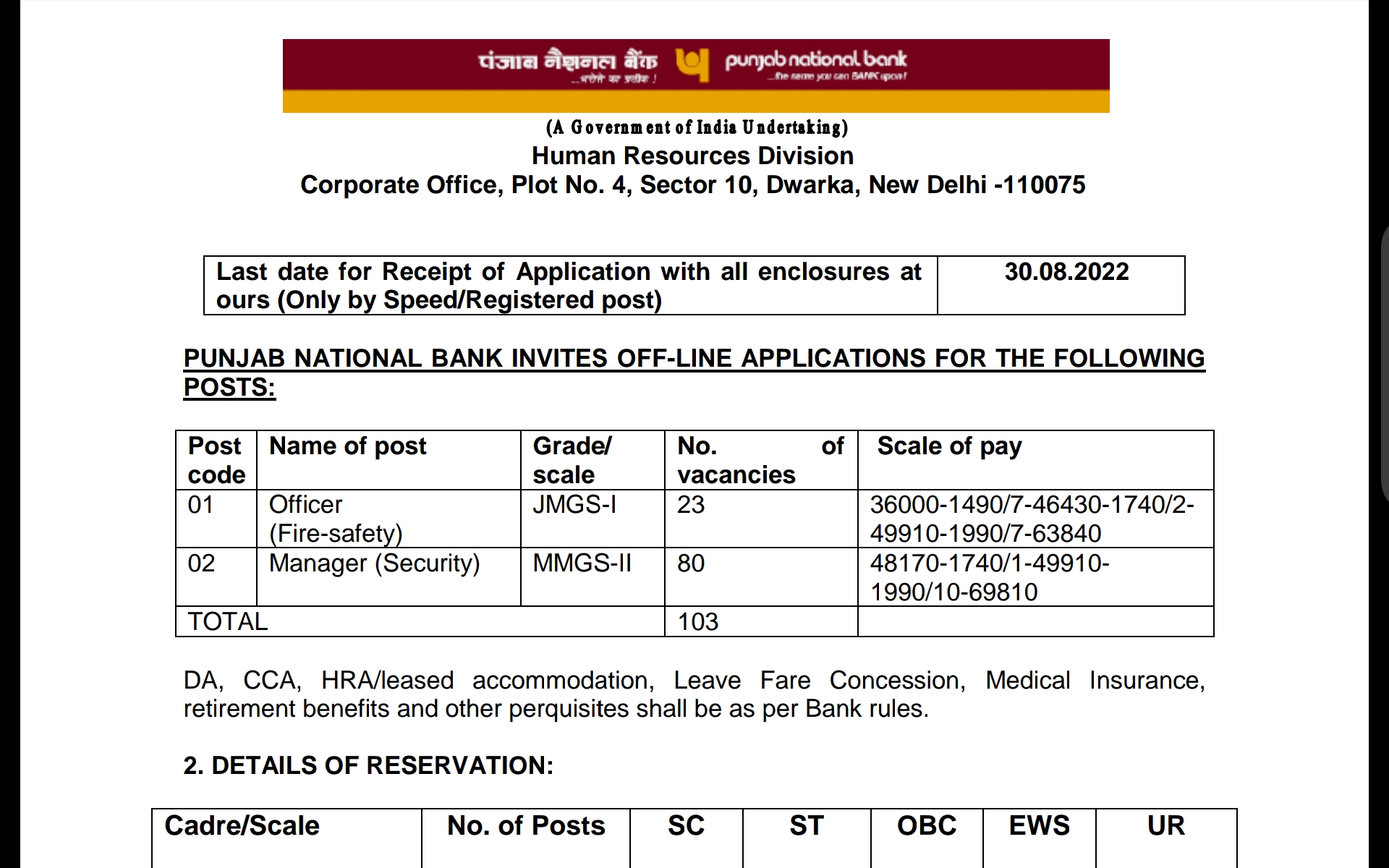
PNB recruitment || latest government jobs August 2022


3. ELIGIBILITY CRITERIA: -

3.1) NATIONALITY/ CITIZENSHIP: 

A candidate must be either –


i. a Citizen of India or 

ii. a subject of Nepal or 

iii. a subject of Bhutan or 

iv. a Tibetan Refugee who came over to India before 1st January 1962 with the 

intention of permanently settling in India or

(A) The level of educational qualifications prescribed for the posts is minimum. Candidates 

must possess above qualifications/ work experience as on 01.07.2022 and must 

produce Mark sheets & Provisional Certificate/ Degree Certificate issued from the 

Board/ University if called for interview. The result of the qualification prescribed must 

have been declared on or before 01.07.2022. The exact date of declaration of result

should be explicitly mentioned in the Degree certificate or any other certificate issued 

by the university. Otherwise, the date appearing on the Mark sheets / Provisional


Certificate/Degree Certificate shall be reckoned for deciding eligibility. No 

correspondence shall be entertained in this matter.

(B) Candidate must specifically indicate the percentage obtained in Graduation/Post 

Graduation degree/diploma calculated to the nearest two decimals in the application

form. Where CGPA / OGPA is awarded, the same should be converted into 

percentage and indicated in application form. The candidate will have to produce a 

certificate issued by the appropriate authority inter alia stating that the norms of the 

University regarding conversion of grade into percentage and the percentage of 

marks scored by the candidate in terms of norms. 

(C) Calculation of Percentage: The percentage marks shall be arrived at by dividing the 

marks obtained by the candidate in all the subjects in all semester(s)/year(s) by 

aggregate maximum marks in all the subjects irrespective of honours / optional / 

additional optional subject, if any. This will be applicable for those Universities also 

where Class / Grade is decided on basis of Honours marks only. 

(D) The fraction of percentage so arrived will be ignored i.e. 59.99% will be treated as less 

than 60%.


Sunday, 7 August 2022

Staff nurse recruitment 2022 || latest government jobs 2022 salary ₹18000

       Online applications are invited from the candidates willing to work in mission mode for 

engagement on contractual basis in the following position under NHM, Assam. Candidates have to 

apply online in the NHM, Assam website: https://nhm.assam.gov.in

The undersigned reserves the right to reject any or all applications without assigning any 

reasons thereof. Merely having the requisite qualification & experience will not render the applicant 

eligible for shortlisting.


Staff Nurse 67 

GNM/B. Sc. Nursing course passed from any 
nursing school / recognized institution and 
registered with “Assam Nurses’ Midwives’ 
and Health Visitors’ Council” 

Age : Up to 45 Years as on 1st April 2022. 

Salary
- 18000

For all programme management positions, Computer Proficiency (MS-Office, Internet) is 
desirable. 
Online application will be received till 20/08/2022. Candidates without the above qualification 
need not apply. 


The number of vacancy may vary at the time of recruitment. 
The schedule of interview / selection test for the respective position will be published in the 
website https://nhm.assam.gov.in in due course of time along with the list of provisionally shortlisted candidates.


All applicants are advised to visit the website accordingly. No separate individual call letter for 
interview/ selection test will be sent. No TA/DA will be paid for attending the interview/ selection test. 
N.B.: The earlier advertisement vide No. NHM-31013(11)/68/2019-HRD-NHM/ 2217-2224 dated 
05/05/2020 for the positions of Addl. Consultant HRD & Addl. Consultant (M&E) & No. NHM-
31013(11)/82/2018-HRD-NHM/24677 dtd. 23/12/2020 for Dental Surgeon have been cancelled.
Sd/- 
(Dr. Manoj Kr. Choudhury)
Executive Director, 
National Health Mission, Assam

Government nursing job in Andhra Pradesh 2022


GOVERNMENT OF ANDHRA PRADESH
HEALTH, MEDICAL AND FAMILY WELFARE DEPARTMENT
NOTIFICATION FOR THE POST OF MID LEVEL HEALTH PROVIDER ON 
CONTRACT 
Applications are invited from the eligible candidates to the post of MID LEVEL 
HEALTH PROVIDER (1681 posts) to be filled on contract basis initially for period of one 
year in the Dr YSR Village Health clinics-Health and Wellness Centres. Number of 
posts are tentative and may increase or decrease as per the need of the department.

Notification check here 

Eligibility Criteria:

Qualification: Must possess BSc. (Nursing)/B.Sc (nursing with integral CPCH

course).


Age limit: 18 years to 35 years as on 01.08.2022 and five years relaxation ( 

40 Years ) in case of BC, SCs, STs , EWS and Physically 

Handicapped and10 years for Ex-service man.

Method of 

Appointment: Appointment is purely on contract basis for a period of One

 year.

Application fee: Rs.500/- for OC candidates and Rs.300/-for SC, ST,EWS and 

 BCs candidates. 

Remuneration: Rs.25,000/- per month. No stipend or salary will be paid during 

the training period.

Selection criteria:

Selection of the candidates is based on the merit of marks secured in the Online 

Entrance Test and duly following the Rule of Reservation and the Presidential Orders 

governing the local status of the candidates. The local area of the candidate will be 

decided based on their study from 4th class to 10th class or the certificate issued by 

Tahsildhar in the prescribed format.

The candidate will be allotted the Test Centre as per their priority to the possible 

extent. However, the department has the right to change the Test Centre of any 

candidate based on the number of applications received for a particular centre. 

SN Name of the ZONE Districts covered

1 Zone- I

Srikakulam,Vizianagaram and Visakhapatnam

2 Zone-II East Godavari, West Godavari and Krishna

3 Zone - III Guntur, Prakasam and Nellore 

4 Zone - IV Chittoor, Kadapa, Ananthapur and Kurnool

The candidates belonging to the districts and Zone as mentioned in the above 

will be considered as local for that zone. Any candidate, who wants to apply for a Zone 

other than their local Zone, will be considered as Non-local.

Applicants can apply online From 09.08.2022 to 22.08.2022

Website Address hmfw.ap.gov.in and cfw.ap.nic.in

Downloading of Hall tickets From 24.08.2022 to 30.08.2022

Date of Entrance Examination Tentatively scheduled to held in the first week of 

September. The exact date will be indicated in the 

Hall ticket and shall also be displayed at : 

hmfw.ap.gov.in and cfw.ap.nic.in

Mode of Examination Online :

2

The candidate is required to attend the exam on a 

computer system. The Question and Multiple 

choice answers will be displayed on the screen 

and the candidate has to choose the correct 

answer.

Type of Examination Questions with Multiple Choice options on the 

syllabus of B.Sc., (Nursing)

No. of Questions 200

Time duration 180 Minutes (3 hours)

Venue of the examination Will be indicated in the Hall Tickets

Issue of Hall Tickets The candidates have to download the Hall ticket 

from the portal and get a printout and attend the 

Exam along with any photo identity proof. 

Selection of the candidate Will be based on the marks obtained in the online 

examination.

Final selection of the 

candidate as MLHP

Based upon the merit list of the online 

examination selection shall be made. If the 

applicant not having B.Sc Nursing with CPCH 

course as an integral part on selection he/she 

shall have to pass Bridge course conducted by 

the IGNOU on their own cost. However necessary 

facilitation for joining the candidates to the bridge 

course will be done by the department. 

The last date for uploading of online application forms is_22.08.2022

Application will be available online : www.cfw.ap.nic.in and www.hmfw.ap.gov.in

Documents to be produced at that time of Selection for verification:

SN Particulars of the Certificates to be enclosed.

01. SSC or equivalent examination (for date of birth)

02 Intermediate examination or 10 + 2 Examination

03 B.SC (N) examination pass certificates (Provisional or Degree)

04. Marks Memos of B.Sc., (Nursing) all years

05 Certificate of Permanent Registration in Andhra Pradesh Nursing & Midwives 

Council 

06 Copy of Caste / Community Certificate in case of SC/ ST / BC (with categorization)

/ EWS issued by the Revenue authority’s viz., Tahsildar / MRO Concerned. In the 

absence of proper caste certificate, the candidate will be treated as OC candidate.

07 Study Certificates for the years 4th to 10th class from where the candidate studied 

(Government / Private / Aided / Municipal / ZP) or certificate of local status issued 

by Tahsildhar in the prescribed format. 

08 In case of private study of 4th to 10th class, 7 years Local status certificate from 

the Tahsildar / MRO Concerned should be enclosed.

09 Copy of latest Physically Handicapped Certificate issued by SADAREM in respect 

of candidates claiming reservation under PH Quota

10 CPCH integrated programme in B.Sc (Nursing ) certificate if available 

11 Copy of certificate of Ex-Service man if applicable.

12 Copy of certificate in support of sports quota if applicable.

Note: Candidates other than B.Sc. Nursing if applied for this post, their 

application will summarily be rejected.

3

Annexure – I

TERMS AND CONDITIONS OF SELECTION AS “ CANDIDATE”

1. Basic qualification. 

1.1: Candidate must have B.SC (nursing ) with CPCH as an integral part or B.Sc 

(Nursing). However, the B.Sc (Nursing) candidates if selected in the online 

examination, shall have to complete the CPCH bridge course conducted by IGNOU on 

their Own Cost within a period of 6 months and pass the examination conducted by the 

IGNOU within the time frame specified by IGNOU. 

1.2 The deployment of the Candidate as MLHP will be purely on contractual / 

conditional basis, and the Candidate will have no right to claim for appointment on 

permanent roll in State Health Department / State Health Society or permanent 

absorption.

1.3 Contractual / Conditional placement and posting thereof to any Dr. YSR Village 

Health Clinics ( Health & Wellness Centre )within the State, will be at the discretion of 

the Competent Authority.

1.4 Along with acceptance of the offer, the Candidate of B.SC Nursing without CPCH

is required to submit duly filled in application of admission to the Bridge Programme 

(Certificate) in Community Health (to be obtained from the IGNOU Programme 

Prospectus)

General

2.1. The Candidate will anytime be subject to be terminated as per the terms and 

conditions of his/her employment, including the Conduct, Discipline etc. and such other 

rules and administrative orders that may be in force from time to time during the Bridge 

Programme too.

2.2. Candidate’s selection is subject to:

2.2.1. Candidate should not be suffering from any medical disability or illness, which is 

likely to hamper Candidate’s selection, including posting at DR YSR Village Health 

Clinics Health & Wellness Centers. In case it is detected at a later stage that Candidate 

had concealed any information pertaining to Candidate’s medical status, the 

Department /State Health Society will be forced to cancel the offer of selection. In case 

of such evidence coming to light after Candidate’s joining, Candidate’s services 

(Contractual/conditional) will be liable for termination without notice at any time and 

Candidate will accordingly cease to be in the employment (Contractual/conditional) of 

the State Health Department/State Health Society.

2.2.2. The State Health Department/State Health Society reserves the right to post 

Candidate at any of its Sub Centres/Health & Wellness Centers within the State, 

if needed.


4

2.2.3. The offer of selection is liable to be withdrawn at any point before joining and if 

joined, liable for termination without notice if competent authority come across 

any evidence/knowledge that the qualification, caste/category and/or any other 

particulars indicated by the Candidate in his/her application/personal resume/ 

other forms/formats submitted to the competent authority are not 

recognized/false/misleading and/or amounts to suppression of information 

/particulars/ facts, which should have been brought to the notice of competent 

authority.

2.2.4. Inadvertent omission or commission or mistakes, if any, appearing in the offer 

of selection are liable to be rectified at any time before or after joining to bring the 

terms and conditions of offer in accordance with the extant policy/rules and 

regulations of the State Health Department/State Health Society that may be in 

force from time to time.

2.2.5. The above terms and conditions are not exhaustive and this offer is subject to 

the understanding that during period of Programme and subsequent service 

(Contractual/conditional), Candidate will be governed by the relevant rules, 

regulations and administrative orders that are framed from time to time. 

2.2.6. Extension in joining time will not be granted formally and the candidate should 

join on the scheduled date itself. Else, the offer may be subject to cancelation 

and withdrawal without further notice to the candidate. However, the competent 

authority/MD, NHM may grant suitable extension in joining time on a case to 

case basis.

2.2.7. Candidate will honor and observe the State Health Department/State Health 

Society’s vision, mission and values at all times to maintain high esteem of the 

State Health Department/State Health Society.

3. Legal Matters

3.1. Any Legal proceeding in respect of any matter of claim or dispute arising out of this 

offer of selection shall be instituted in the High court of Andhra Pradesh only.

.

 Sd/-J.Nivas,I.A.S.,

Director of Health & Family Welfare,

Mission Director, NHM.AP.


AIIMS Recruitment senier Residents August 2022

 No. AIIMS/RBL/REC/SR/2022/209 Dated: 23.07.2022

ADVERTISEMENT FOR RECRUITMENT TO THE POST OF SENIOR 

RESIDENTS UNDER GOVT. OF INDIA RESIDENCY SCHEME IN AIIMS, 

RAEBARELI 

AIIMS, Raebareli is an apex healthcare institute, established by the Ministry of Health 

& Family Welfare, Government of India under the Pradhan Mantri Swasthya Suraksha Yojna 

(PMSSY). 

Executive Director, AIIMS, Raebareli invites offline applications for the post of Senior 

Residents under Govt. of India Residency Scheme for the following Departments initially for 

one year and subsequent extension of 2 years shall be granted depending upon the 

performance and conduct.

Sl. 

No Department Number of Vacancy

UR OBC SC ST EWS Total

1. Anaesthesiology 2 0 0 1 0 3

2. Biochemistry 1 0 0 0 0 1

3. Dentistry 1 0 0 0 0 1

4. Dermatology 0 1 0 0 0 1

5. Medicine 4 1 0 1 0 6

6. Microbiology 1 1 0 0 0 2

7. Obstetrics and Gynaecology 0 1 2 0 0 3

8. Ophthalmology 0 1 0 0 0 1

9. Orthopaedics 1 0 0 0 1 2

10. Otolaryngology 1 0 0 0 1 2

11. Paediatrics 1 1 0 0 1 3

12. Pathology 2 1 0 0 0 3

13. Psychiatry 1 0 0 0 0 1

14. Radiology 2 0 0 1 0 3

15. Surgery 2 2 2 0 0 6

16. Transfusion Medicine 0 1 2 0 0 3

Total 19 10 6 3 3 41

Note:

1. As per guidelines EWS posts are not carried forward / or considered as backlog 

vacancy in case unfilled hence other category candidates may be allowed provisionally 

to apply for post subject to the condition that they will be considered for the post as an 

UR Candidate only if EWS category seat is otherwise not filled.

2. 4% reservation for PwD candidates on horizontal basis as per Government Rules.

अखिल भारतीय आयुर्विज्ञान संस्थान, रायबरेली

All India Institute of Medical Sciences, Raebareli

(An Autonomous Institute under the Ministry of Health and Family Welfare, Govt. of India)

Munshiganj, Raebareli - 229405, Uttar Pradesh, India

www.aiimsrbl.edu.in

ESSENTIAL QUALIFICATIONS:

1. SENIOR RESIDENTS (Non-Academic):-

a) A medical qualification included in the first or second schedule or Part II of the third 

schedule to the Indian Medical Council Act 1956 (persons possessing qualifications 

included in the Part II of the third schedule should also fulfil the conditions specified in 

Section 13 (3) of the Act).

b) Must be registered with the Central/State Medical Council.

c) A postgraduate degree i.e. MD/MS/DNB in the specialty concerned or its equivalent.

d) For Pathology Department: the essential qualification shall be MD Pathology/MD Lab 

Medicine.

AGE LIMIT: Senior Resident 

Age limit for post of SR is 45 years (relaxable by 5 years for SC/ST candidates and 3 years 

for OBC candidates).

In case of Physical Handicapped (OPH) candidates, age relaxation up to a maximum period of 

ten (10) years for General Category, Thirteen (13) years for OBC category and fifteen (15) 

years for SC/ST category candidates. 

PAY SCALES: Senior Resident

In Pay Matrix (Level-11) with a minimum of Rs.67,700/- + NPA (for medical personnel) as 

per recommendations of the 7th CPC. 

2. APPLICATION FEES: 

For General/OBC/EWS: Rs. 1,000/- , 

For SC/ST category: Rs. 800/-, 

For PWBD category application fee is exempted. 

Application fee is required to be remitted through Demand Draft payable in favour of 

Executive Director, AIIMS, Raebareli. The Application fee is non-refundable. Application 

sent without fees shall be summarily rejected.

3. PROCESS OF SELECTION:

The selection of Senior Residents will be done through -

a) Written Examination (MCQ based) - 80% weightage

b) Departmental assessment - 20% weightage

ESSENTIAL QUALIFICATIONS:

1. SENIOR RESIDENTS (Non-Academic):-

a) A medical qualification included in the first or second schedule or Part II of the third 

schedule to the Indian Medical Council Act 1956 (persons possessing qualifications 

included in the Part II of the third schedule should also fulfil the conditions specified in 

Section 13 (3) of the Act).

b) Must be registered with the Central/State Medical Council.

c) A postgraduate degree i.e. MD/MS/DNB in the specialty concerned or its equivalent.

d) For Pathology Department: the essential qualification shall be MD Pathology/MD Lab 

Medicine.

AGE LIMIT: Senior Resident 

Age limit for post of SR is 45 years (relaxable by 5 years for SC/ST candidates and 3 years 

for OBC candidates).

In case of Physical Handicapped (OPH) candidates, age relaxation up to a maximum period of 

ten (10) years for General Category, Thirteen (13) years for OBC category and fifteen (15) 

years for SC/ST category candidates. 

PAY SCALES: Senior Resident

In Pay Matrix (Level-11) with a minimum of Rs.67,700/- + NPA (for medical personnel) as 

per recommendations of the 7th CPC. 

2. APPLICATION FEES: 

For General/OBC/EWS: Rs. 1,000/- , 

For SC/ST category: Rs. 800/-, 

For PWBD category application fee is exempted. 

Application fee is required to be remitted through Demand Draft payable in favour of 

Executive Director, AIIMS, Raebareli. The Application fee is non-refundable. Application 

sent without fees shall be summarily rejected.

3. PROCESS OF SELECTION:

The selection of Senior Residents will be done through -

a) Written Examination (MCQ based) - 80% weightage

b) Departmental assessment - 20% weightage

4. DOCUMENTS TO BE PRODUCED IN ORIGINAL AT THE TIME OF Document 

verification:-

The Candidate should bring following original documents and one set of self-attested 

photocopies at the time of document verification in case of his/her selection:-

1. Identity Proof (PAN Card, Passport, Driving License, Voter Card, Aadhar Card etc.)

2. Address Proof.

3. Certificate showing Date of Birth. (Birth Certificate/10th Certificate). No Age relaxation 

would be available to SC/ST/OBC candidates applying for unreserved vacancies.

4. Photocopies of PAN Card and Bank Passbook and four recent passport size photographs 

(At the time of Joining for only selected candidates)

5. Class 10th & 12th Marksheet and Certificates.

6. Essential Qualifying degrees:

a. MBBS/BDS Marksheet and degree certificate.

b. MD/MS/DNB or equivalent degree certificate.

7. Attempt and Internship Completion Certificate.

8. Registration with Medical Council of India /State Medical Council & DCI for Dentistry 

candidates.

9. Experience Certificate (if have).

10. FMGE certificate conducted by NBE (For foreign graduate). 

11. Reservation category Certificate (OBC*/SC/ST/PH) (*Candidate should belong to non-

creamy layer of Central List of OBC in Government of India format). 

12. In case of OBC candidate, the OBC certificate must be issued within one year (Older 

certificate not be entertained). 

13. In case of EWS candidate, the EWS certificate must be issued on or after 01st April, 2022 

to last date of application and be valid for financial year 2022-23. 

14. Candidates working in Government Institution- No Objection Certificate.

Candidates who do not produce the above mentioned original documents at the time of 

document verification shall not be offered appointment even though if he/she is selected 

on the basis of examination and Departmental assessment.

General Conditions

1. The aspiring applicants satisfying the eligibility criteria in all respects can submit their 

application by speed post/registered post/courier/by hand in the office of the Senior 

Administrative Officer (Recruitment Cell), All India Institute of Medical Sciences, 

02nd floor, Medical College Block, Munshiganj, Dalmau Road, Raebareli-229405 on 

or before 16th August 2022. Applications received after 16th August 2022 shall be 

summarily rejected. 

2. The applicants applying in response to this advertisement should satisfy themselves 

regarding their eligibility for the aforesaid post and must fulfill all the eligibility 

criteria on or before the last date of submission of form i.e.16.08.2022, failing which 

their application will be rejected. 

3. The application form duly filled with all requisite documents and Demand Draft for

fee should be sent by Speed post/Registered post/by hand to the office of the Senior 

Administrative Officer, Recruitment Cell, 2

nd Floor, Medical College Block, 

AIIMS Raebareli, Munshiganj, Dalmau Road, Raebareli- 229405.

4. The envelope should be super-scribed as “APPLICATION FOR THE POST

OF ……………………IN DEPTT OF ……………..” along with below mentioned 

documents (self-attested):

I. Printout of the online application form.

II. Candidate Brief/Application form in prescribed format 

III. Mark sheets and degrees (Qualification proof).

IV. Proof of Age. 

V. Caste Certificate ST/SC/OBC/EWS (In the prescribed format as per GoI norms) 

VI. Experience Certificate. 

VII. NOC (No Objection Certificate) for those Candidates who are working in 

Central/State Govt. Organizations/Autonomous Bodies including those working 

on contract/Adhoc basis 

VIII. Two passport size Photographs.

IX. Medical Council registration.

X. Demand Draft

5. Important Dates:

Last date of submission of application form: 16.08.2022 (5:00 PM)

Date of written examination: 20.08.2022 

Date of Departmental Assessment: 22.08.2022

Term and Conditions

1. The appointment is initially for a period of One (01) year, which may extendable up 

to three (03) years based on performance & conduct.

2. The leave entitlement of the appointee shall be as per the Central Residency Scheme 

and Institute Policy.

3. The appointee shall perform the duties as assigned to him/her. The competent 

authority reserves the right to assign any duty as and when required. No 

extra/additional remuneration will be admissible in case of such assignment.

4. The Competent Authority reserves the right to change the number of vacancies, 

withdraw the process in full or in part and also the right to reject any or all 

applications received without assigning any reasons or giving notice etc.

5. The appointment to the said post will be subject to medical fitness from the competent 

Medical Board for which he/she will be sent to the designated Medical Authority of the 

Institute.

6. This appointment is full time and private practice of any kind is prohibited.

7. The appointee is not entitled to any TA/DA for attending the examination and Departmental 

assessment or joining the Institute.

8. If any declaration given or information furnished by him/her proves false or if he/she is found 

to have wilfully suppressed any material information, he/she will be liable for removal from 

service and also such other action as the Institute may deem necessary.

9. The decision of the competent authority regarding selection of candidates will be final 

and no representation will be entertained in this regard.

10. Incomplete applications in any aspect will be summarily rejected.

11. In case of any inadvertent mistake in the process of selection which may be detected 

at any stage even after the issue of appointment letter, the Institute reserves the right 

to modify/withdraw/cancel any communication made to the candidate.

12. The applicant will be responsible for the authenticity of submitted information, other 

documents and photograph. Submission of any false and/or suppression /concealment 

of facts shall lead to rejection/ cancellation of selection/recruitment. 

13. In case of need of any assistance or clarifications regarding the recruitment please 

contact: recruitment.aiimsrbl@gmail.com or call on 0535-2979743. All further 

updates related with this advertisement shall be published in the Institute website 

only. Candidates are advised to regularly visit the Institute website 

www.aiimsrbl.edu.in for updates and information. 

Executive Director.


Thursday, 4 August 2022

Top 10 health insurance in the world

 With the rising instances of diseases and accidents, the demand for health insurance has shown significant growth. A health insurance plan can provide you with financial security in times of a medical emergency. Every individual has certain risks and uncertainties in life The best way to tackle health risks is to purchase a health insurance cover.

Health is Wealth' and therefore, it's essential to care for you and your family's health. With rising costs of hospitalisation and medical treatment, having a health insurance/medical policy is essential. It not only ensures you don't go bankrupt after an illness, but also provides sufficient coverage. Most importantly, even if you don't have to avail it, you get health insurance tax benefits.

Below are some of the top 10 health insurance in the world

Here are some of the best international health insurance companies:


  1. Bupa Global
  2. IMG.
  3. AXA.
  4. Generali Global Assistance.
  5. Cigna.
  6. Allianz Worldwide.
  7. William Russell.
  8. GeoBlue.
  9. Expacare Global Healthcare.
  10. A Plus International

Wednesday, 3 August 2022

Top 10 endangered species on earth

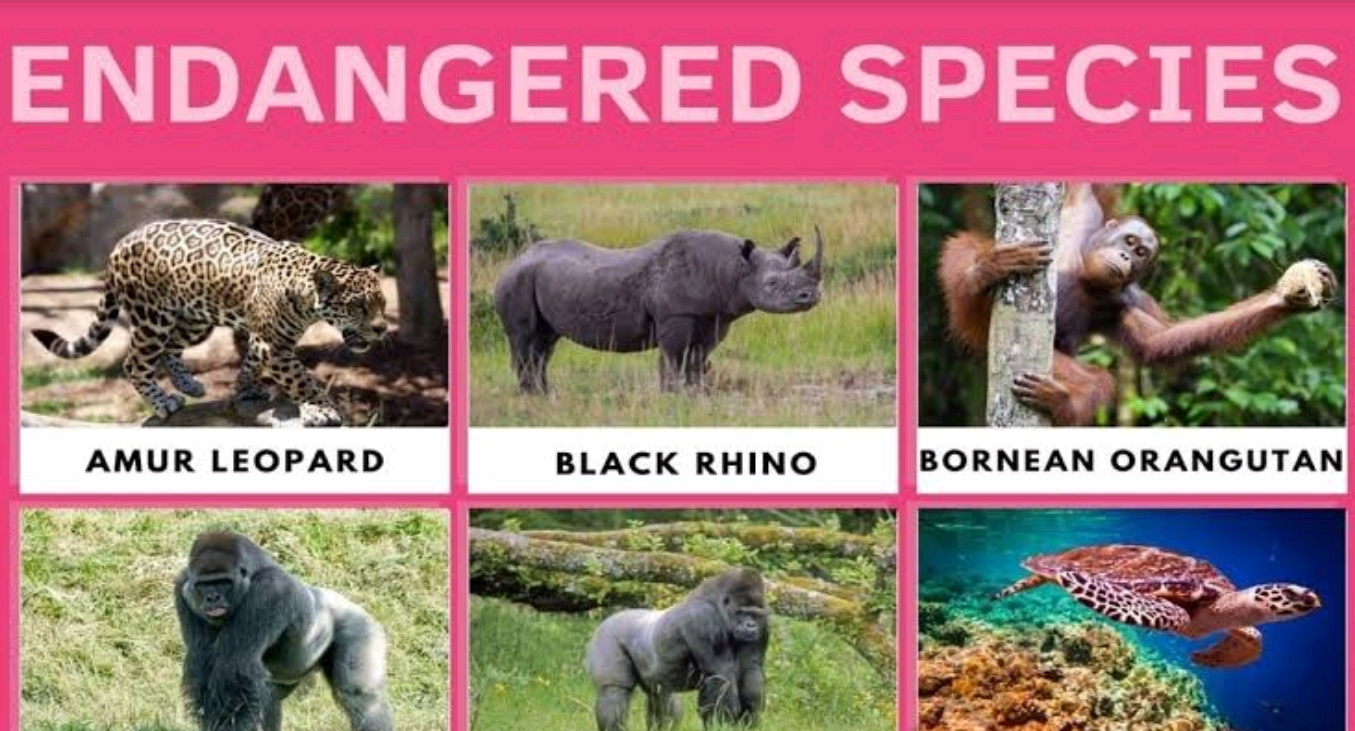
 1. Amur Leopard

First on the list of the world’s most endangered animals in 2022 is the amur leopard. Between 2014 and 2015, there were only around 92 individuals left in their natural range. This number is now estimated to be around 84. They are extremely vulnerable to poachers, who kill them for their coats and bones, the latter of which is sold for use in traditional Asian medicine. They are at risk of habitat loss due to natural and man-made fires. Climate change is also leading to a decrease in prey availability.


2. Rhino

Rhinos are one of the most poached animals on the planet. Their horns are used in traditional Chinese medicine and displayed as a symbol and demonstration of wealth. A Javan rhino horn can sell for up to USD$30,000 per kg on the black market. Because of poaching, three of the five species of rhinos are among the most endangered animals in 2022: the black rhino, the Javan rhino and the Sumatran rhino. The Javan rhino is the closest to extinction with only around 60 individuals left, all of which are in Ujung Kulon National Park in Indonesia, while black rhino population is estimated to be around 5,500 individuals.


We believe in Compassionate Humanity

Join us in the Fight for Our Children's Future

BECOME AN EO MEMBER TODAY

3. Orangutan

The two kinds of orangutan – the Bornean and the Sumatran Orangutan – have both experienced sharp declines in populations. A century ago there were probably more than 230,000 orangutans in total, but the Bornean orangutan is now estimated at about 104,700 based on updated geographic range and the Sumatran about 13,846. They are primarily threatened by habitat loss from human-caused deforestation for palm oil. 


4. Gorilla

There are two species of gorillas, the Eastern gorilla and the Western gorilla, which both have two subspecies. Three out of four are Critically Endangered on the IUCN Red List of Threatened Species. The only one that isn’t is the Mountain Gorilla, a subspecies of the Eastern Gorilla, which is considered Endangered. There are only around 200-300 adult Cross River Gorillas left in the wild. Like many endangered animals, their decline is mostly due to poaching, habitat loss, disease and human conflict. Gorillas are also slow to recover as they have a low reproductive rate, with females only giving birth every four to six years. One female will breed three or four times in her lifetime.


5. Saola

Often called the Asian unicorn, the saola is one of the rarest mammals on the planet and for this reason, it makes the list of the world’s most endangered animals in 2022. It was first discovered in 1992 in the Annamite Range in Vietnam and is rarely seen. No formal surveys have been undertaken to determine accurate population numbers, but the IUCN estimates the total saola population to be less than 750, likely to be much less.


6. Vaquita

As both the smallest and most endangered marine mammal in the world, the vaquita has been classified as critically endangered by the IUCN since 1996 and experts say there may only be about 10 individuals left, despite extensive conservation efforts. Their biggest threat is from the illegal fishing of totoaba, a large fish in demand because of its swim bladder. Vaquitas accidentally end up entangled in the gillnets set for totoaba and drown because they can no longer swim to the surface to breathe. Conservation efforts led to the introduction of a ban on gillnets in vaquita habitat back in July 2016, but illegal fishing continues, and the threat remains. Efforts now focus on enforcing the ban on gillnets and persecuting those that use them. Conservationists are also working to decrease demand for totoaba, which is a protected species.


You might also like: Top Vaquitas Facts to Know About


7. Sunda Tiger

Of all the big cats, tigers are the closest to extinction. with fewer than 3,900 tigers remaining in the wild, they exist in only 4% of their historic range. Sunda tigers in particular are especially vulnerable. With numbers estimated to be at fewer than 400 today, accelerating deforestation and rampant poaching mean it could end up extinct like its Javan and Balinese counterparts. Despite increased efforts in tiger conservation – including strengthening law enforcement and anti poaching capacity – a substantial market remains in Sumatra and other parts of Asia for tiger parts and products. 


8. Yangtze Finless Porpoise 

Finless porpoises live in the Yangtze River in China. Unfortunately, they are vulnerable to fishing; even though they are not directly targeted by fishermen, large numbers of the species die when they become accidentally entangled in fishing gear. The waters they live in are also constantly busy with fishermen and people using the waterways to move around, so they get injured and killed by boats and ships. Additionally, their waters are also affected by high levels of toxic pollutants. There are between 1,000 and 1,800 finless porpoises left in the Yangtze. The annual decline rate of 13% means these animals are expected to become extinct within 10 years if there are no effective conservation actions in place. 


9. Turtle

Two species of sea turtle are critically endangered on the IUCN Red List of Threatened Species: Hawksbill Turtles and Kemps Ridley Turtles, while Leatherback sea turtles are classified as vulnerable, though the population is decreasing and several subpopulations are facing extinction. Hunting is one of the biggest threats to sea turtles, with poachers targeting their eggs, shells, meat and skin. They are also at risk from habitat loss, bycatch and pollution as well as climate change. Sand temperature determines the sex of hatchlings with eggs developing as females in warmer temperatures. That means even small temperature changes could skew the sex ratio of populations. 


Recent estimates show us that there are nearly 6.5 million sea turtles left in the wild with very different numbers for each species. Population estimates for the hawksbill turtle range from 83,000 to possibly only 57,000 individuals left worldwide. Kemp’s Ridley and Flatback turtles each have a very narrow distribution, with less than 10 000 individuals left for each species (medium estimates: 25,000 and 69,000 respectively).


You might also like: 10 of the Most Endangered Species in the Ocean


10. Elephant

Last on the list of the world’s most endangered animals in 2022 are elephants. While some populations of African elephants are increasing, primarily in southern Africa, numbers are continuing to fall in other areas, particularly in central Africa and parts of East Africa. With an estimated 415,000 elephants left on the continent, the species is regarded as vulnerable, although certain populations are being poached towards extinction. Asian elephant numbers have dropped by at least 50% over the last three generations, and they’re still in decline today. With only 40,000-50,000 left in the wild, the species is classified as endangered. However, the species most at risk is the Sumatran elephant, with a population of about 2,400-2,800 individuals.


As we reflect on this list on National Endangered Species Day, let us be reminded of the work that still needs to be done to ensure that these species and all others continue to inhabit the planet for generations to come.


Monday, 1 August 2022

Who Invented Radio?

 During the 1860s: Scottish physicist, James Clerk Maxwell predicted the existence of radio waves; and in 1886, German physicist, Heinrich Rudholph Hertz demonstrated that rapid variations of electric current could be projected into space in the form of radio waves similar to those of light and heat.


In 1866: Mahlon Loomis, an American dentist, successfully demonstrated "wireless telegraphy." Loomis was able to make a meter connected to one kite cause another one to move, marking the first known instance of wireless aerial communication.

Guglielmo Marconi: an Italian inventor, proved the feasibility of radio communication. He sent and received his first radio signal in Italy in 1895. By 1899 he flashed the first wireless signal across the English Channel and two years later received the letter "S", telegraphed from England to Newfoundland. This was the first successful transatlantic radiotelegraph message in 1902

Sunday, 31 July 2022

Top 10 richest people in all over the world


 1. TopElon Musk

 is the richest man on the planet and has accumulated much of his wealth having founded Tesla. However, Musk has long been occupied with several other well-known companies and had his roots within a group known as the “PayPal Mafia.” This consisted of serial entrepreneurs and angel investors that made up PayPal’s alumni, who have been extremely successful in their own right. 

2. Bernard Arnault

  • Age: 73
  • Nationality: France
  • Company: LVMH
  • Net Worth: $148.1 billion
  • Industry: Fashion and Hospitality

Bernard Arnault amassed his fortune in the luxury goods industry with the ownership of world-renowned brands such as Louis Vuitton and Christian Dior. By targeting wealthy demographics and maintaining a 47% stake in his company, LVMH, he has climbed his way to the top of the food chain just like many others on this list. 


3. Jeff Bezos

  • Age: 58
  • Nationality: USA
  • Company: Amazon
  • Net Worth: $139.4 billion
  • Industry: E-commerce and Technology

At 30 years old, Jeff Bezos left the finance industry to start a business that many saw as foolish — buying and selling books online. That company is known today as Amazon, and it’s currently valued at more than $1 trillion. Bezos is credited for pioneering the e-commerce landscape, which has become one of the largest industries in the world. 

His creation didn’t just disrupt bookstores; it disrupted traditional retailers on many fronts. He transformed Amazon into a platform where shoppers can buy and sell almost everything and developed one of the most sophisticated logistics companies in the world. Not stopping there, Amazon grew to include Amazon Prime Video and Amazon Web Services and it is now the largest cloud service provider in the world. 


4. Bill Gates

  • Age: 66
  • Nationality: USA
  • Company: Microsoft
  • Net Worth: $124.6 billion
  • Industry: Technology

Bill Gates was a tech-whiz kid growing up, having designed his first software program at age 13. What wasn’t known then was that he would go on to become a co-founder of Microsoft, the largest computer software company in the world. Microsoft was first founded in 1975, but Gates decided to step down as CEO in 2000.

5. Larry Page

  • Age: 49
  • Nationality: USA
  • Company: Google
  • Net Worth: $99.7 billion
  • Industry: Technology and Advertising

Larry Page co-founded Google in 1998 and was CEO until 2001. He returned as CEO from 2011 to 2015 and remains a board member and majority shareholder. Nowadays, Google has moved under the umbrella of Alphabet, the tech conglomerate holding company that owns YouTube, Google Play, Android, Fitbit, Mandiant, Looker and Nest. 

Google first built its search engine but repeatedly redefined technology with developments in GPS mapping and translation. This, in turn, led to the creation of one of the largest platforms for advertising in the world — to the good fortune of Page. Last year alone, Google generated $209.49 billion in total ad revenue.

6. Gautam Adani

  • Age: 60
  • Nationality: India
  • Company: Adani Group
  • Net Worth: $99.2 billion
  • Industry: Energy and Transportation

Gautam Adani is the richest person in India, and his entrepreneurial DNA comes directly from his father, who owned a textile business. Despite the opportunity to inherit, Adani had no interest in the business and decided to follow his own ambitions to achieve great wealth. Soon after leaving home, Adani entered the diamond industry, which saw him quickly rise to millionaire status. 

Upon acquiring this wealth, he founded Adani Enterprises, a conglomerate that now oversees several businesses in sectors such as energy, transportation, mining, infrastructure, logistics, cement and fast-moving consumer goods. Thanks to India’s economic growth, Adani’s stock market success and recent investments in green energy have added more than $40 billion to his net worth over the past year, propelling him toward the top of the rich list.

7. Larry Ellison

  • Age: 77
  • Nationality: USA
  • Company: Oracle
  • Net Worth: $97.1 billion
  • Industry: Software

Like many others on this list, Larry Ellison can attribute his great fortune to the rise of technology. Having founded Oracle in 1977 after dropping out of college, he grew the company from its start-up phase to one of the largest software and database companies in the world. Oracle now has a market capitalization of 187.7 billion, and Ellison has retained a stake of more than 40% to date. 

Ellison made his own fortune, but thanks to substantial investments he made in Tesla before its meteoric rise, he generated a net gain of more than 1,000% on his capital. He joined Tesla’s board of directors in 2018; however, Tesla announced in June that Ellison would step down. He still holds about 1.5% of Tesla’s total outstanding shares.

8. Warren Buffett

  • Age: 91
  • Nationality: USA
  • Company: Berkshire Hathaway
  • Net Worth: $97 billion
  • Industry: Investing and Finance

Nicknamed the “Oracle of Omaha,” Warren Buffett is regarded as the greatest investor of all time. His holding company, Berkshire Hathaway, manages a portfolio of investments that include large positions in Apple stock as well as several bank stocks. Buffett has long spoken about the benefits of compound interest that have helped him accumulate his fortune. 

Even as it continues to work in his favor, Buffett has pledged to give 99% of his wealth to charitable foundations and philanthropic causes during his final years, and he has already donated $45.5 billion. Despite his vast wealth, Buffett doesn’t live in a multi-million-dollar mansion. Instead, he still resides at the same Omaha house he bought in 1958 for just $31,500.

9. Sergey Brin

  • Age: 48
  • Nationality: Russia
  • Company: Google
  • Net Worth: $95.9 billion
  • Industry: Technology and Advertising

Sergey Brin, along with Larry Page, co-founded Google. So it’s no surprise he also made it onto the list of the richest people in the world. The pair met at Stanford University before starting their venture, and just like Page, Brin continues to hold an active role as a board member with a similar stake. More recently, Brin set up Bayshore Capital Management in Singapore, a region ripe for investment with favorable tax legislation, to manage his wealth.

10. Mukesh Ambani

  • Age: 54
  • Nationality: USA
  • Company: Reliance Industries Limited
  • Net Worth: $92.1 billion
  • Industry: Energy, Telecommuncations, Retail

Mukesh Ambani serves as chairman and managing director of Reliance Industries Limited, which grew from the yarn trading company his father started in 1957 to become India’s largest private-sector company.

After earning a degree in chemical engineering, Ambani enrolled in Stanford University’s MBA program but left to return to India to help his father grow the business. Ambani is credited with expanding Reliance from textiles and polyester fibers to petrochemicals and petroleum refining, and ultimately to oil and gas exploration and production. Today, Reliance is also India’s largest retailer, and it operates the world’s largest 4G broadband wireless network.

Physics viva important question 2024 by Gurleen

  1. To determine resistivity of two / three wires by plotting a graph for potential difference versus current. 1. Define Ohm’s law. Answer...